
Utility Network: A Strategic Decision, Not Just a Migration
For many water utilities, the conversation around Esri’s Utility Network (UN) has shifted from if to when. Following ArcMap’s deprecation in March 2026, the timeline feels more defined — and for some, more urgent. At the same time, uncertainty remains:
- What is the right way forward for our organization?
- How do our existing integrations influence the pace and structure of change?
- Which UN capabilities align with today’s needs — and which can wait?
Framing Utility Network as a strategic decision, not just a software migration, helps organizations move forward with clarity and confidence.
The Myth of a Single “Right” Implementation
Utility Network is often discussed as a single destination, rather than a journey with multiple possible routes. In practice, no two UN implementations look exactly the same, nor should they.
Local governments and water utilities operate under real constraints: limited staff, tightly integrated asset management systems, regulatory obligations, and budgets that must be justified carefully. For these organizations, the concern is rarely about the value of Utility Network itself. It is about the impact of change — on operations, on people, and on the systems on which they rely every day.
The most successful implementations begin by acknowledging a reality:
Adopting Utility Network is not just a technical upgrade; it's an organizational decision.
Building Confidence — and Capability
While moving all utilities to the Utility Network at once is one path forward, many organizations benefit from a phased transition that aligns with their capacity, priorities, and long-term vision.
Depending on readiness, that might mean:
- Starting with a focused dataset or a single utility (such as water, wastewater, or sewer)
- Preparing data models and governance before full migration
- Improving data quality and connectivity to support network tracing and analysis (valves, mains, manholes, laterals, inlets, outfalls, lift stations)
- Updating workflows and roles so the organization—not just the GIS—can sustain the change
These incremental steps are not delays. They are investments in sustainability and a smoother Utility Network go-live.
A Conversation, Not a Prescription
There is no universal roadmap for Utility Network. What works for one organization may not work for another, even within the same region or utility type.
The most productive starting point is often a conversation — one that focuses less on software and more on goals, constraints, and readiness. From there, a path forward can be shaped that accounts for the organization’s realities while following proven best practices.
The transition to UN is not about doing more, faster. It is about doing what makes sense, at the right time, in the right way.
Success Depends on Alignment
Utility Network is a powerful platform. When implemented with intention, it supports:
- More informed decision-making
- Improved data integrity and trust in the system
- A foundation for future innovation
Achieving those outcomes requires more than a checklist — it requires alignment between technology, people, and purpose.
These questions and considerations reflect thoughtful organizational stewardship. Pro-West brings decades of expertise in water utility GIS, ArcMap and Geometric Network workflows, and their transition to Utility Network. Whether you are just starting to think about UN, or if you are headed into a full implementation or migration, we are here to help provide thoughtful and strategic guidance for long-term success.
Learn More
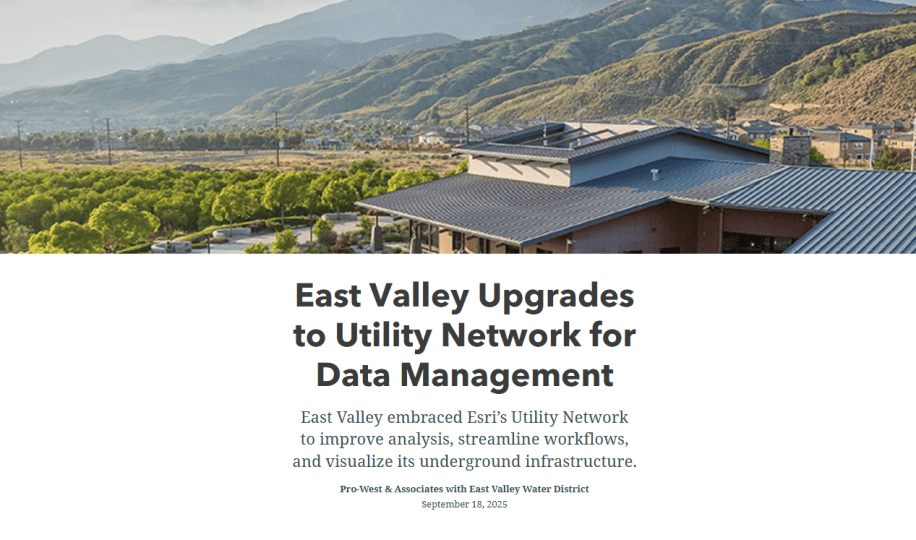
CASE STUDY: EAST VALLEY WATER DISTRICT IMPLEMENTS UTILITY NETWORK
MEET WITH OUR EXPERTS
Pro-West offers free consultations to help local government organizations determine their GIS needs. Email Marcus Glass, Business Development Director by clicking on the button below.